Saint-Saëns: Cello Sonata Bits 'n Bobs
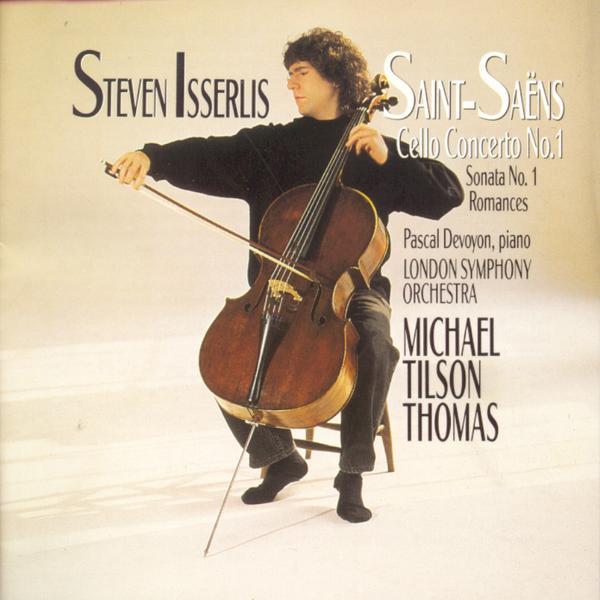
This Recording Roundup covers the two Cello Sonatas from Camille Saint-Saëns as played by British cellist Steven Isserlis. I already covered the Cello Concertos from Isserlis (BLOG), thus it only seemed natural to continue with the sonatas for that instrument. Plus, the second recording below reuses the very same Cello Concerto no. 2 I heard, so I threw the coupled Cello Sonata no. 2 into this roundup instead of a separate redundant review.

Cello Sonata no. 1
Carnival of the Animals: XIII: Le Cygne
Boy, am I glad I didn't pass this one over! Just like Saint-Saëns' Cello Concerto no. 1, his Cello Sonata no. 1 in C minor is full of swirling drama and musical invention. Every musical turn impressed me from start to finish. While my favoritism could be due to the C-minor key, which consistently holds its grip on the work throughout, there is a tight-knit structure which keeps everything from running loose.
As to this recording, I think the piano is balanced slightly too forward. Saint-Saëns, being a virtuoso pianist, created a work just as devilishly difficult for the piano as it is for the cello, so I imagine balancing could be precarious. Here, the cello tone from Steven Isserlis becomes somewhat lost in its lower range, or when the piano is instructed to play powerfully. If this is bothersome, Tortelier is a front runner to check out as well. Most impressive, though, is Pascal Devoyon's firm keyboard work aside Isserlis.
While there are other cello/piano works on this recording aside the sonata (check out the back cover image at the bottom of this blog post for those extras), I chose the penultimate movement from The Carnival of Animals for this Recording Roundup. Not only is The Swan a famously beautiful movement, but this recording features not only US conductor Michael Tilson Thomas at the piano, but he is further joined by British actor Dudley Moore as the third and fourth hands of the piano duet with cello. Film comedian Moore was an extremely fine concert pianist, as well as a musical humorist at the keyboard, thus it is nice to hear him on a high profile recording, even if he doesn't receive credit on the cover for his small role.
Cello Sonata no. 2 in F Major
Romance, op. 67
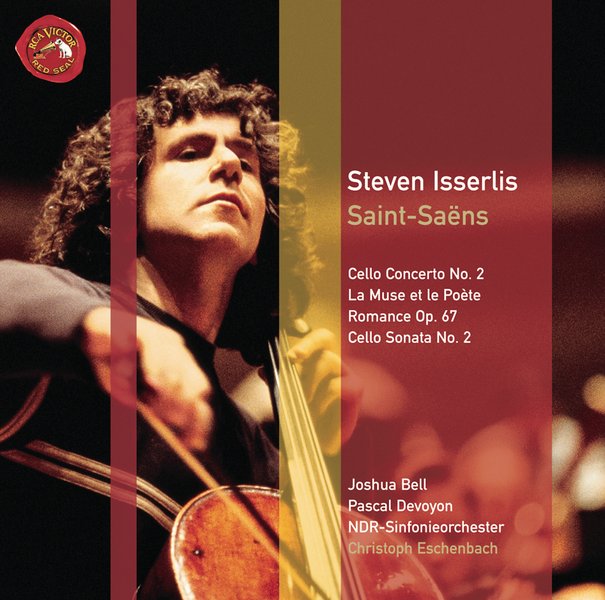
If it is easy to pair the qualities of the First Cello Concerto to the First Cello Sonata, so it is between Cello Concerto no. 2 and the Cello Sonata no. 2 in F Major. Both works are less popular than their earlier sister compositions, and both have a wider, epic scale to them, even if the moods are more tempered in comparison.
It is the two inner movements which take center stage for this listener, the second movement a Scherzo and Variation and the third movement a Romanza of High Romanticism. The former sounds rhythmically tricky, and while Saint-Saëns occasionally holds back the tempo, most of the movement is a frantic burst forward. The latter movement is really the only time the composer allows the cello to truly sing, something I had been waiting for up until this point, but Saint-Saëns had not yet really provided the listener.
The final movement is a bit of a let down for me, never really exploding into a joyous F Major, committing to a more temperate, gentle musical stance instead. On the other hand, listen to some of the complex harmonic progressions the composer writes; some of it is truly unexpected. Plus, what a chance RCA took pairing two less-oft-performed works together from Saint-Saëns. I guess they were banking on the name of Isserlis, and for good reason, as these are wonderful sounding performances, with a much better sonic balance between Isserlis and Devoyon.
The Opus-67 Romance comes with orchestra, here in the form of the North German Radio Symphony Orchestra under Christoph Eschenbach, who also conducts the Cello Concerto no. 2 on this same recording (which I already covered on this blog). The Romance is a lovely work, both lyrical and perky at times, making for a decent Romantic miniature, and finding Saint-Saëns at his most French.
Cello Sonata 1 in C minor, op. 32
Carnival of the Animals, R125: XIII: Le Cygne
Steven Isserlis, cello
Pascal Devoyon, piano
Michael Tilson Thomas & Dudley Moore, pianos
RCA, 1993
Cello Sonata 2 in F Major, op. 123
Romance, op. 67
Steven Isserlis, cello
Pascal Devoyon, piano
NDR Symphony Orchestra
Christoph Eschenbach, conductor
RCA, 1999; 2001
Find more Saint-Saëns recordings HERE!


Comments
Post a Comment