Bizet: Symphony in C Major

If you want a light, bubbly program of orchestral music, this one is your ticket. Sunshine and smiles follow this music from start to finish, with Bizet's wonderful Symphony in C Major headlining. Gaîté Parisienne features music by French opera composer Jacques Offenbach, reworked into a one-act ballet by Manuel Rosenthal. Two additional overtures, including the famous Can-Can, round out a smiling program.
A Review from 2020
This 1999 Bernstein Century release features Bizet’s youthful Symphony in C, Offenbach’s Gaîté Parisienne as arranged by Manuel Rosenthal in addition to the complete Overture to Orpheus in the Underworld, and Suppé’s Galathée Overture. These performances are led by Leonard Bernstein with the New York Philharmonic and are culled from various stereo recordings placed down between 1963-1970.
The prize of the recording is Bizet’s Symphony in C, a sunshiny, spirited symphony in four rather characterful movements. The liner notes liken his symphony to that of Gounod, and the clunky opening unison motive certainly makes it seem like we are heading into Gounod’s (and Von Weber’s) chaste territory, but that is ultimately selling the unique characteristics of Bizet’s work short. The 1st movement’s developmental hunting horn echoes, the 3rd’s nigh-upon Irish reel replete with Scotch drones, and the 4th’s swift fiddling display Bizet as charming, inventive, and original, not a classicist clone. The pinnacle is the 2nd movement, one that is akin to Tchaikovsky’s yearning melancholy, wholly brought to fruition through that aching oboe solo. Furthermore, Bizet’s use of pizzicato strings has rarely been as effective as it is throughout this symphony and he interestingly moves the bass line into constant action and cogently leads his triumphant return to themes through its use.
Moreso, Bernstein’s advocacy of Bizet’s early Symphony is springy, exciting, and full of life and gusto. It should be noted, that Bernstein omits the exposition repeats in the 1st and 4th movements but takes all of the repeats in the 3rd, making this a fairly quick reading. Add to that Bizet’s markings of Allegro Vivo and Allegro Vivace in 3 of the 4 movements, ones which Bernstein makes into virtuoso orchestral showpieces, particularly in the outer movements, and you have some of the most raucously joyous performances of this work. Sony’s sound is really good here too.
As to the classic Beecham recording of Bizet’s Symphony now on Warner Classics, Bernstein is certainly more extroverted and his sound is much better than Beecham’s rather tubby stereo, but some might enjoy the less overt showmanship from that reading. In comparison to Sir Neville Marriner on EMI, who takes all of Bizet’s repeats, the weight and size of the New York Philharmonic is much appreciated over Marriner’s balletic daintiness; in the end it’s all up to one’s own tastes.
Sony gives some substantial pairings to Bizet’s Symphony in the form of Offenbachian light music. It should be noted that Gaîté Parisienne, a later arrangement by Manuel Rosenthal that collated various parts of Offenbach’s operas for orchestra and ballet, is here in a truncated form, normally over 30 minutes in length and around 20 tracks of endless waltzes. I do like Bernstein’s shorter version, it cuts some of the endless fluffy chaff, but Sony also includes his entire Orpheus in the Underworld Overture, the one with the famous can-can dance that is also supplied at the end of Parisienne, so they make an oddly redundant bedfellow. As highlights, the strings lean sensuously into the Barcarolle, the cello solo in the first half of the overture is rapturously strong-armed, the violin solo is properly weepy, and both solos are closely miked. Franz von Suppé’s Overture to The Beautiful Galatea is much along the likes of the Offenbach: whipped-creamed light entertainment with catchy melodies and characterful rhythms that supply endless smiles with no effort to dig deep into human soul searching.
I am not as enamoured with the sound on these later entries, it is a tad coarse and boomy and make New York sound a bit like a noisy circus band. However, they are stirringly energetic and Bernstein imbues them with boundless energy, grit, and enthusiasm, so perhaps they need little more. Arthur Fiedler, in better RCA Living Stereo sound, gives the complete Gaîté Parisienne with the Boston Pops and Zubin Mehta has a full set of Suppé Overtures on CBS with the Vienna Philharmonic that are both pretty successful endeavors. I will admit that I don’t think either of these recommendable alternatives reach the outwardly combustible performances as led by Bernstein.
For me, this recording is a prime recommendation for the Bizet Symphony, and while the filler material is more substantial than some Bernstein Century releases, it is music of thrills and light music, but not much more. These are sunny and joyful performances though, and comes recommended overall.
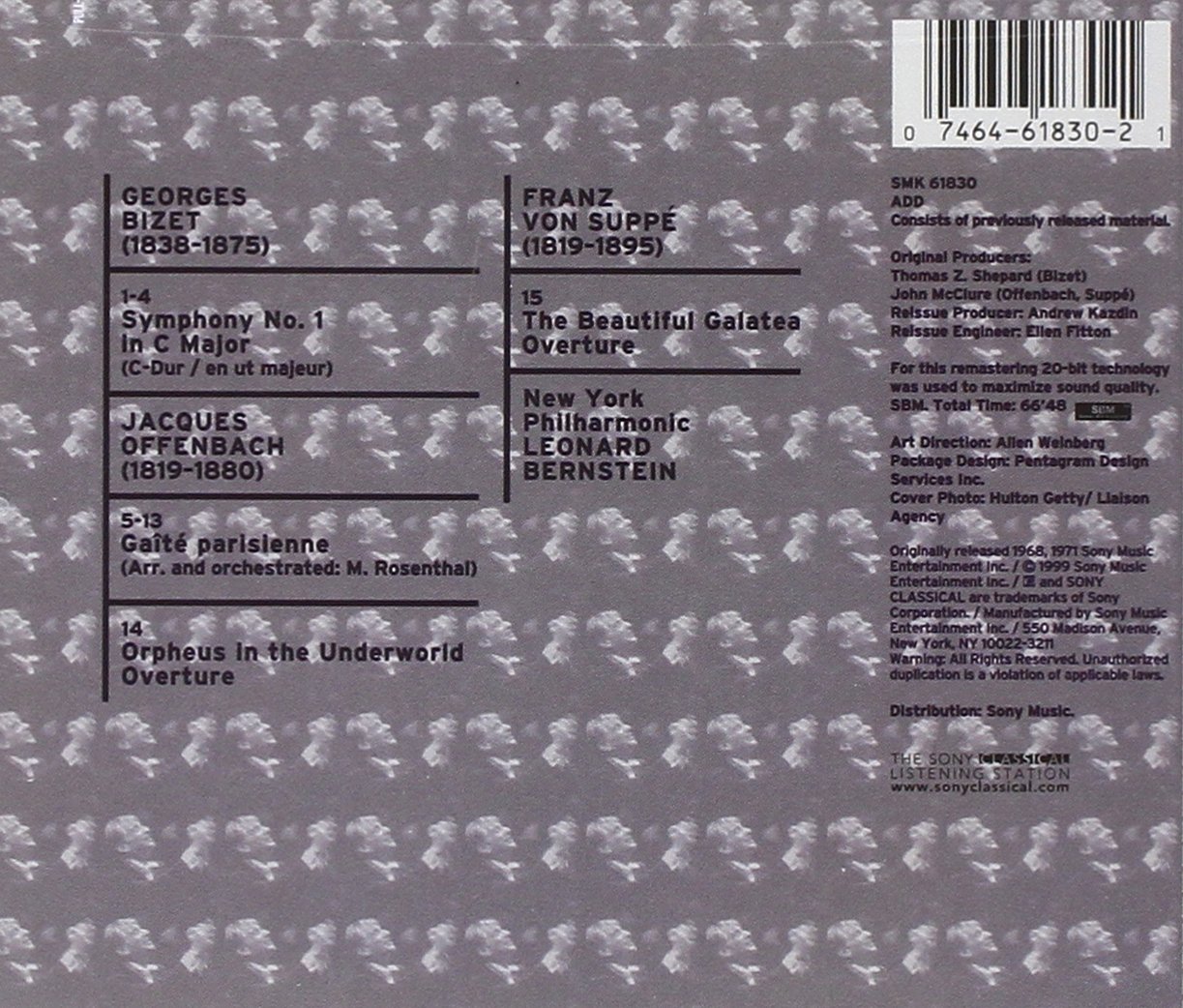
Works
Georges Bizet
Symphony in C Major (27.51)
Jacques Offenbach
Gaîté Parisienne (21.02)
Orphée Aux Enfers: Overture (9.42)
Franz von Suppé
Die Schöne Galathée: Overture (7.48)
Ensembles
New York Philharmonic Orchestra
Leonard Bernstein, conductor
Label: Sony
Year: 1999
Total Timing: 66.48
On a single listen, be prepared for oodles of light buoyancy. Individually, these pieces are energetically given life by Bernstein and NY.
This is one of the very finest performances of Bizet's Symphony in C Major, however; the highlight of this CD.

Comments
Post a Comment