I will admit I am a little obsessed with narration and music. I have found not many share my enthusiasm for this genre, but I suppose it matters not.
Sir William Walton's
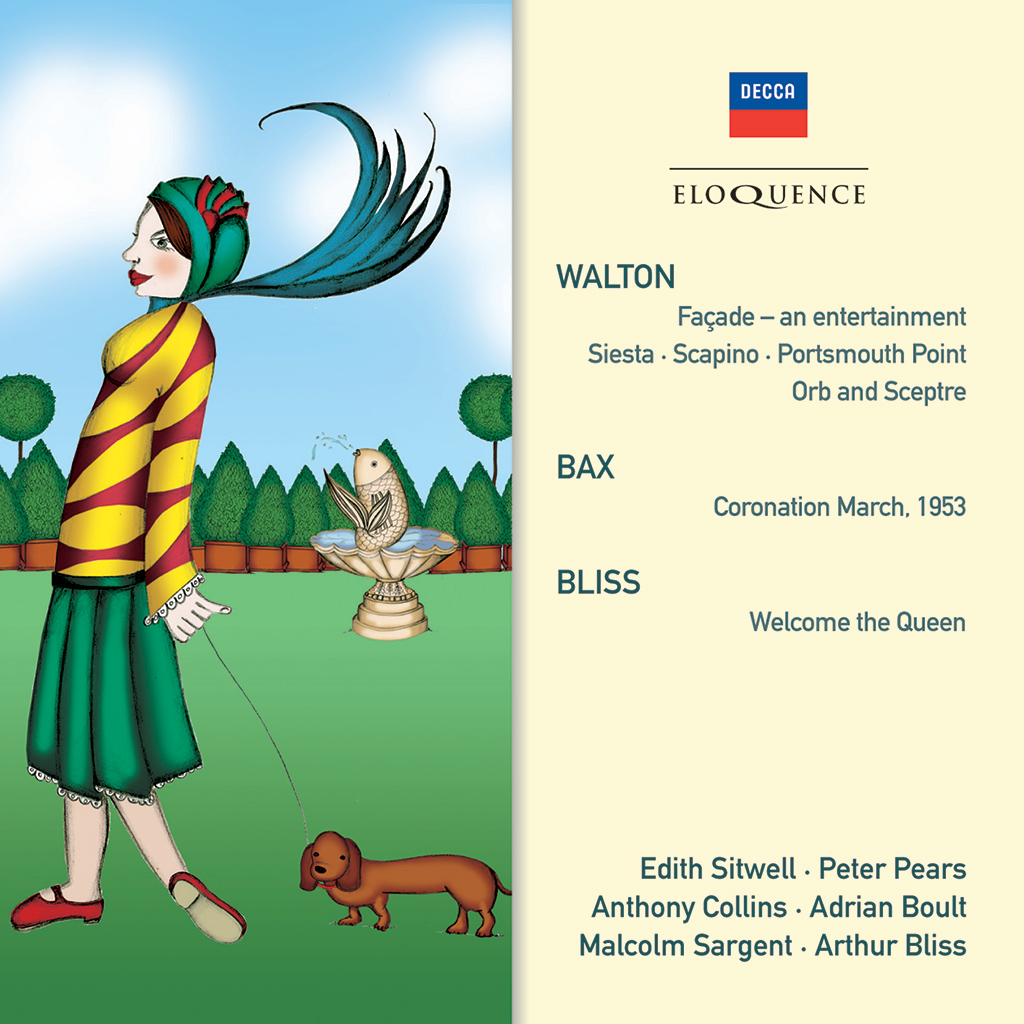
Façade is a sort of early-20th Century performance art. Edith Sitwell wrote pithy and nonsensical rhyming verse which is spoken in time to music composed by William Walton. I especially love the British drawl of Sitwell herself on this recording, a vocal styling which contrasts well with Peter Pears' piping tenor.
I am no lover of mono recordings, but this one sounds out well enough during
Façade, easily making room for spoken word and an extended chamber ensemble led by Anthony Collins. Where the mono really bothers me is in the short orchestral works which follow. There is much congestion in the orchestral sound, and there are many stereo recordings of these Walton, Bax, and Bliss miniatures to enjoy elsewhere.
A review from 2019
Australia’s
Decca Eloquence presents a host of music by William Walton and single
marches by Arnold Bax and Arthur Bliss featuring classic performances
from the 50’s of orchestras around London led by conductors Anthony
Collins, Sir Adrian Boult, Sir Malcolm Sargent, and Sir Arthur Bliss.
The
flagship composition of the disc is Edith Sitwell’s bit of eccentric
performance art, Façade, a marriage of spoken word and instrumental
music, in this case, a small chamber ensemble of winds and percussion /
jazz ensemble in the form of the English Opera Group Ensemble providing
rhythmic emphasis to Sitwell’s onomatopoeically rhyming verse that is
geared more towards sound utterances rather than storytelling. Walton’s
sparse, but often jazzy instrumental music is vivid and witty, but
really takes a backseat to the narrators, one reason he made so many
orchestral Suites of this music found elsewhere.
This
1953 recording features a mid-sixty-year old Edith Sitwell, who had
been performing these works since the 1920’s, and is joined here by the
musical Peter Pears on a few of the more rhythmically swift settings.
Sitwell’s authoritative readings are a joy, her voice of a low-toned
aging, aristocratic dowager whose life was dedicated to the written
word, confidently traversing her cheeky lexicon that comes across so wry
for her voice style; Sitwell avoids the theatricality of the numerous
recordings that have followed over the last 60 years, putting the sole
focus on her words in her singular syrupy English elocution that stands
surprisingly close to Sprechstimme. Peter Pears, whose fluting, Baroque
timbre is often criticized in his singing, gives a spry, twinkling
reading that is unusually clear-eyed, if not a bit one-note once he gets
going. The work as a whole is an eccentric romp, few works compare
easily to this style, but it is entertaining and Pears and Sitwell’s
performance is hard to beat. Lest I forget, this is an excellently
colourful mono recording, with Sitwell and Pears heard up close with
great detail, Sitwell only rarely competing against the instruments in
her timbre, and the background winds and percussion get an amazing
amount of depth and clarity for the recordings age and source; an easy
first choice performance of Façade!
As to the rest of the music,
Boult leads the evocative Siesta, a comedic Scapino overture, and a
brawny and bustling Portsmouth Point overture from a 1955 performance.
The sound is a bit more pinched and congested compared to Façade,
Scapino’s loud upper registers and tambourine clashing in the older
sound, but despite that, Boult gives the music a ton of energy, my
favourite of the trio Portsmouth Point unusually burly and epic, but
Siesta leaving me yearning for a clearer soundscape. Sir Malcolm
Sargent’s sound with the LSO is a smidgen better, with less harsh brass
and percussion in Orb and Sceptre and Bax’s Coronation March, but
Sargent is not as impetuous as Boult, showing instead the grandness of
these English compositions in sweeping performances. Only Arthur Bliss’
1959 Welcome the Queen, led by Bliss himself, is truly sonically
satisfying from a modern perspective in these instrumental works, caught
with a nice stereo spread and whipping his own music into a pompous
fervor. All of Walton’s (Bax and Bliss included) instrumental works are
easy on the ears with fine melody writing and dramatic orchestrations
and easily recommended for excellent performances, albeit in older
sound. Not that I don’t like the Bax and Bliss, but it would have been
nice to have a true William Walton compilation with Crown Imperial,
Spitfire, or Johannesburg to fill out the program, but what is here is
good.
Despite the physical media not included any texts, this
performance of Façade is the best place to start for the quirky
composition, if nothing else than for its authoritative performances by
Sitwell herself and Peter Pears. The sound quality on Decca Eloquence is
excellent in Façade, and although the classic Boult and Sargent
performing the instrumental works is older sounding, the performances
are direct and energetic, and Bliss’ stereo account sounds very good.
This Façade performance can also be found on Alto with different pairings, and Walton’s instrumental works were covered exhaustively on Chandos and a later recording by Sir Charles Groves on EMI.
Regardless, this recording comes enthusiastically recommended for its
Façade performance, but overall a four-star recommendation for the
entire album.

Works
William Walton
Façade
Siesta
Scapino
Portsmouth Point
Orb and Sceptre
Arnold Bax
Coronation March
Arthur Bliss
Welcome the Queen
Soloists
Dame Edith Sitwell, narrator
Peter Pears, narrator
Ensembles
English Opera Group Ensemble
Anthony Collins, conductor
London Philharmonic Orchestra
Sir Adrian Boult, conductor
London Symphony Orchestra
Sir Malcolm Sargent, conductor
Sir Arthur Bliss, conductor
Label: Decca Eloquence
Year: 1953-59; 2010
Total Timing: 77.24
 I am here for Façade, and that is where this recording is at its best. Having Dame Edith Sitwell reading her own poetry is an absolute treasure.
The rest of the program is led by such podium luminaries as Sir Adrian Boult, Sir Malcolm Sargent, and Sir Arthur Bliss. Unfortunately, the mono sonics in these other orchestral works don't make listening easy.
Find more Walton recordings HERE!

Comments
Post a Comment