I love these quirky oratorios from Beethoven. I can't say the famous composer didn't write much for chorus, since there is plenty of music from Beethoven to hear. Yet, large-scale works are not quite as numerous, nor as popular.
This recording is a rather lovely performance, although at 47 minutes in length, I wish something else was paired with
Christ on the Mount of Olives.
A review from 2020
Beethoven’s
lone oratorio, Christus am Ölberge (Christ on the Mount of Olives), is
given a rather starry presentation on this Harmonia Mundi release. It is
led by Kent Nagano and the Deutsches Symphony Orchestra Berlin from the
early 2000’s, and features soprano Luba Orgonasova, tenor Placido
Domingo, and bass Andreas Schmidt alongside the Berlin Radio Chorus.
Despite
being a Passiontide setting, Christ at the Garden of Gethsemane,
Beethoven’s composition is rather operatic in nature, or at least that
is the approach by Kent Nagano and company. The boisterous choruses
could be ripped straight from Berlioz’s Faust for all the hale and
hearty soldiering that comes across in the ensemble numbers. This
operatic aspect is only furthered by the spotlight on Placido Domingo
who gives a drippingly Italianate reading and the larger voiced soprano
Orgonasova. Those looking for serious, pious devotionality probably
won’t be pleased here, but I have always enjoyed a little spectacle in
my sacred choral works, and Harmonia Mundi’s presentation goes that way.
At
over 60 years of age, this is probably Placido Domingo’s last solid
recording in an oratorio-type setting before his voice settles into
baritone land. His voice might not be as effortless as it once was, but
it is certainly solid tenor work with only a few moments where I noticed
he had to prepare for the big moments a little more than in the past.
Slovak soprano Luba Orgonasova is a little large-voiced for the
proceedings, but she allays any fears in her big “whistle range” aria
which shows great flexibility, sensitive singing of texts, and facile
bravado without any display of Eastern-European wobble. Andreas Schmidt
unfortunately does display some wobble, an aspect I am not used to from
him, but his small role towards the end is not a deal breaker and he
sings well in the more dramatic ensemble moments.
I am really
impressed with the orchestra here; their string tone is fulsome, yet
sensitive, and the wind work is excellent, just listen to that opening
overture. Kent Nagano really coaxes the best out of them, both in the
softest intimate settings and the rousing numbers. As mentioned before,
Nagano seems to be going for an operatic approach through fluid,
forward-moving tempos, a bouncy rhythmic snap, and dramatic climaxes.
The Berlin Radio Chorus is excellent, and while I could imagine the
number of choristers being larger for a more symphonic approach, their
singing is always of the highest calibre and the recording captures them
spaciously and intimately depending on the need. This is really
outstanding choral work, although these seem more operatic choruses than
sacred oratorio, but I suppose it is a fine line.
I don’t think
anyone will be unhappy with this recording, but there are a few others
that make their own mark. Two conductors who have a larger, symphonic
approach are Helmuth Rilling and Sergei Baudo. Rilling on Hänssler and on Brilliant
is a bit more serious of mind and his Stuttgart choirs are always
solid, I just have never been a huge Keith Lewis fan, and Baudo on Harmonia Mundi
is big in texture, yet the acoustic does them no favours. Fritz
Wunderlich’s older recording is in really wonky sound, but his tenor is
always a treasure, and Christopher Spering’s period performance on Naïve
is too thin, coldly percussive, and vibratoless in the orchestra for my
tastes. Most recently, Leif Segerstam has traversed all of Beethoven’s
rare choral and incidental music on Naxos, but he is generally too pokey and his Finnish orchestra, but especially his chorus, were never high on virtuosity.
And
so, we have Kent Nagano on Harmonia Mundi who meets in the middle
between the sacred grandeur of Rilling and the lean period sound of
Spering, but with an emphasis on clean, clear rhythms, operatic
theatrics, and outstanding choral work. Your feelings on Placido
Domingo’s brand of tenor will probably lean you one way or the other on
this album, but I find him in the last vestiges of good voice and Luba
Orgonasova is thrilling. The German orchestra is really top-notch,
giving both weight and suaveness and I am on board with Nagano’s
approach. Texts and translations are included with the physical media,
and although 48 minutes is a spare runtime for a CD, I really like this
music from Beethoven and this performance from Harmonia Mundi captured
in excellent sound.
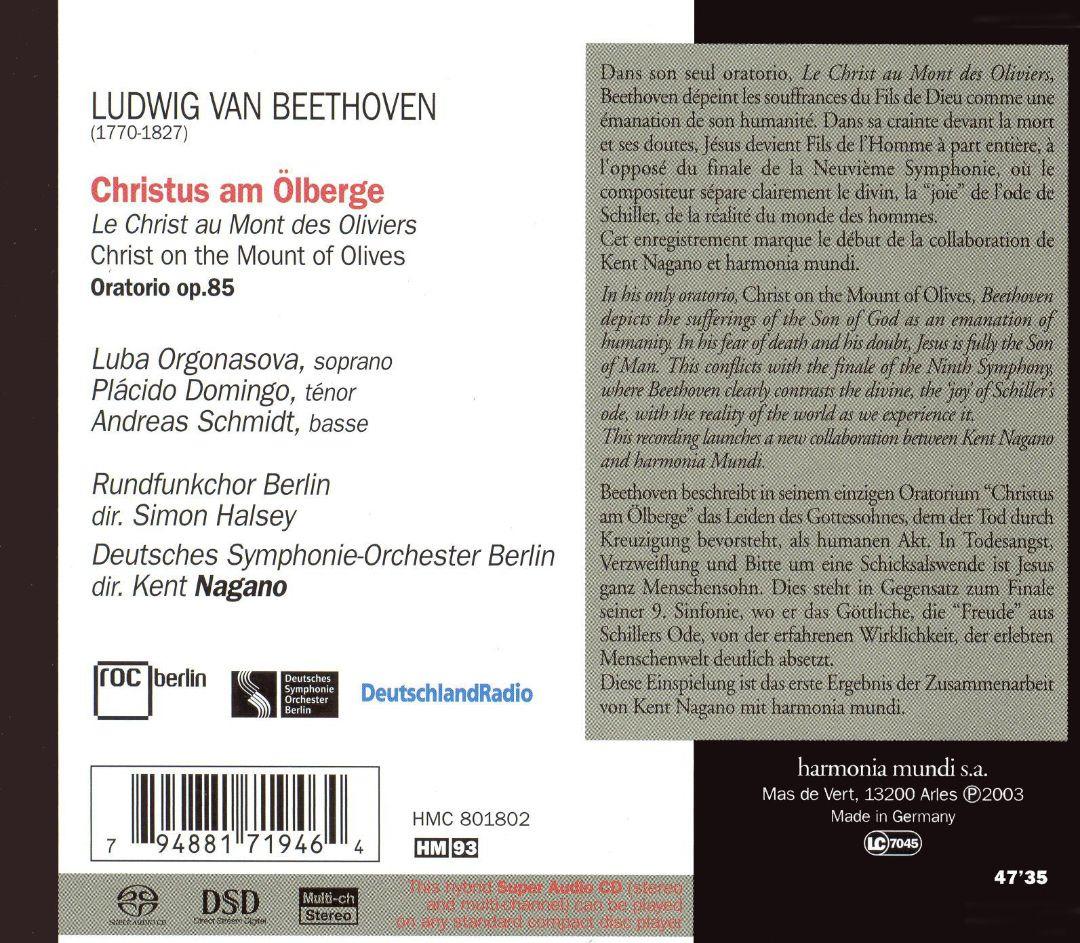
Works
Christ on the Mount of Olives, op. 85
Soloists
Luba Orgonasova, soprano
Plácido Domingo, tenor
Andreas Schmidt, bass
Ensemble
Berlin Radio Choir
Deutsches Symphony Orchestra Berlin
Kent Nagano, conductor
Label: Harmonia Mundi
Year: 2003
Total Timing: 47.35
 If you want nothing but Beethoven's Christ on the Mount of Olives, this recording will give great pleasure
At 47 minutes total, though, I wonder why nothing else was added to flesh out the runtime?
Find more Beethoven recordings HERE!

Comments
Post a Comment